Introduction
As the Generative AI ("GenAI") sector has continued to grow in scale and strategic significance, the scrutiny it has attracted from competition authorities and policymakers has, inevitably, increased. Against this background, this report – the third in a series prepared by RBB Economics for the Computer & Communications Industry Association ("CCIA") – assesses the current state of GenAI competition, with a particular focus on the US, where most frontier development takes place.
Our report focuses on whether competition in the GenAI sector is working well for consumers and enterprise users. That is, whether market conditions are delivering outcomes that are consistent with effective competition – falling prices for a given level of capability, improving model and product quality, wide choice and sustained innovation. With that in mind, the report takes a two-step approach.
First, we directly assess the state of competition at the two layers at which GenAI is supplied to consumers and enterprise users: the AI application layer – the software products, such as AI assistants and coding tools, that consumers and enterprises use day to day, whether standalone or embedded in software they already use – and the foundation model ("FM") layer – the general-purpose models that power those applications and which developers and enterprises access directly, through a provider’s API, a cloud marketplace or aggregator, or by self-hosting.
Second, we assess a range of practices that have been identified by regulators as sources of concern. These are: (i) input foreclosure – whether concentration in compute, cloud and AI chips, and the capital required to compete there, allows the leading providers to raise rivals’ costs at the FM and application layers, and whether FM developers that also compete downstream could do the same to application developers that rely on their models (and whether they have the incentive to do so); (ii) distribution channel foreclosure – whether certain vertically integrated firms have sufficient control over key distribution channels to harm non-integrated rivals (and have the incentive to do so); and (iii) partnerships – whether equity stakes linking cloud providers and chip suppliers with model and application developers create the ability and incentive to disadvantage rivals.
The report assesses each issue using publicly available market evidence, considering whether the concerns are borne out at present, and whether further review would be warranted in the event of changes in circumstances.
Importantly, the assessment offers a point-in-time view of an unusually fast-moving sector, based on data available up to early October 2026. Market positions and the set of active firms have shifted materially within the period under review. This dynamism is generally consistent with a healthily competitive sector. At the same time, were circumstances – notably this evident dynamism – to change, then conclusions might also be different. At each stage, the report distinguishes between what the current evidence shows and what needs to be monitored to guard against future risks to competition.
The state of competition at the AI foundation model and AI application layers
We begin with a direct assessment of the state of competition at the FM and application layers.
In practice, an analysis of the strength of competition often starts with an assessment of shares of supply measured on relevant antitrust markets. Importantly, high shares of supply are not in themselves evidence of a competition problem.1Verizon Communications Inc. v. Law Offices of Curtis V. Trinko, LLP, 540 U.S. 398, 407 (2004), holding that the mere possession of monopoly power ‘is not only not unlawful; it is an important element of the free-market system’; United States v. Grinnell Corp., 384 U.S. 563, 570–571 (1966), which distinguishes the wilful acquisition or maintenance of monopoly power from ‘growth or development as a consequence of a superior product, business acumen, or historic accident’; and United States v. Aluminum Co. of America, 148 F.2d 416, 430 (2d Cir. 1945), per Learned Hand J, that the successful competitor ‘must not be turned upon when he wins’. Firms compete precisely in order to win sales and achieve leading positions, and a high share is often the reward for having competed successfully rather than a sign that competition has failed. However, in cases where persistently high market shares are observed or levels of market concentration are otherwise high, authorities may be concerned that the firms in question are insulated from competition to a sufficient extent for prices to be raised significantly above competitive levels, quality to be degraded or innovation to slow.
We discuss the FM layer and application layer in turn below. In each case, we begin with an assessment of shares of supply, noting where appropriate the challenges associated with such analysis in this sector. Where feasible, we then also comment on other evidence of competitive dynamism that is relevant to our assessment.
The FM layer
Focusing on the FM layer, our assessment indicates that the market is currently subject to effective competition. We observe successful entry, innovation, substantial variation in shares of supply over time and falling prices for a given level of capability.
First, we have assessed shares of supply. It is hard, if not impossible, to provide a single, overall view of shares of supply of FMs given the broad range of ways in which models are deployed and the differing publicly available metrics on which usage is measured. Nor is it within the scope of the report to define antitrust markets at this layer of the supply chain. The approach we take is therefore to triangulate across multiple complementary metrics, each capturing a different dimension of relative position at this level of the supply chain.
Table 1 below summarises the data sources we have assessed and our findings. These data sources show that concentration at any point in time can be high. However, they also indicate frequent and substantial movements in shares over time and numerous examples of market-leading positions being quickly eroded – trends which are consistent with effective competition.
Table 1: Metrics used to assess shares of supply at the foundation model layer
Metric | What it shows | Data source | What the results show |
|---|---|---|---|
Weekly share of token usage | Which model developers route their live traffic to, through a large API gateway, a real-time measure of revealed choice and of how quickly it shifts. | OpenRouter, a marketplace routing developer traffic across hundreds of models; usage measured in tokens processed. | Combined share of Google, OpenAI and Anthropic fell from c.72% (June 2025) to c.29% (June 2026). |
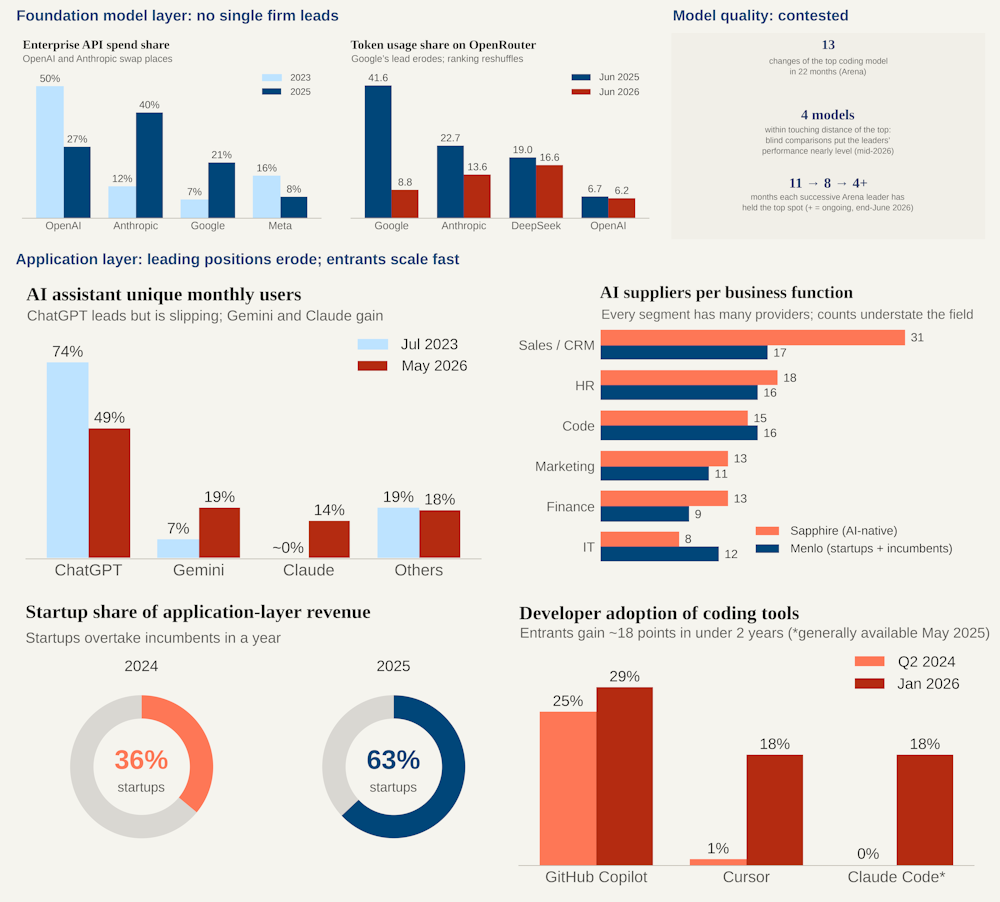
Enterprise model spend | Which models enterprises rely on for production API, by spend – where enterprise budgets are actually committed, rather than where usage sits. | Menlo Ventures survey of US enterprises, recording spend on model access by provider and use case. | OpenAI’s share of spend fell from c.50% to 27% (2023 to end-2025) while Anthropic’s rose from 12% to c.40% and Google’s from 7% to 21%. The top three together account for c.88%. |
Compute-capacity proxies | Forward-looking potential rather than realised shares. | Epoch AI database of large-scale AI models, counting models and developers above fixed training-compute thresholds. | The number of developers training at frontier scale has grown: Epoch AI identified over 30 models from 12 developers above the 10 to the power of 25 FLOP training-compute threshold by June 2025, a scale first reached by a single model (GPT-4) in March 2023. |
Second, we have analysed dynamic indicators of competition at the FM layer. Understanding competitive dynamics, in the form of ongoing investment and innovation in model development, speaks to the contestability of current positions which in turn has implications for an assessment of the strength of competition in a sector: where providers must keep improving their models to retain customers, this is evidence that rivalry continues to act as a constraint on market participants. We therefore ask two questions in turn: how many new models are being produced, and by how many firms; and whether any single developer has been able to hold a durable lead in model quality.
On the first question, over 90 models were released in 2025 alone by 28 different firms, and eight different firms have featured among the top three model developers over the past ten years.2Epoch AI, ‘Data on AI Models’, interactive data explorer, updated 19 June 2026 (accessed June 2026). On the second question, no provider has established a durable quality lead to date: the leading position on the Arena coding leaderboard, which ranks models on blind pairwise votes by users, changed hands 13 times in 22 months, with Google, OpenAI and Anthropic each holding the top position at different points in time.3Arena Intelligence, ‘Text Arena – Coding’, data dashboard (accessed July 2026). The same pattern is corroborated by Artificial Analysis’ leaderboard of model intelligence.4Artificial Analysis, ‘LLM Leaderboard - Comparison of over 100 AI Models from OpenAI, Google, DeepSeek & Others’, data dashboard (accessed July 2026).
Third, we have reflected the important role that open-weights models play in the competitive process in our assessment. Frontier models are closely followed by open-weights models (models whose trained parameters, or ‘weights’, are published so that anyone can download, run and adapt them) that achieve similar levels of performance at substantially lower cost.5Ibid. The July 2026 release of Kimi K3 by Moonshot AI is a clear example of this. It is an open-weights model that matches the performance of leading proprietary models to within a few points on independent benchmarks, yet it was built with a fraction of the resources and is available at a fraction of the cost per token of proprietary frontier models. Moreover, since key information about the model is released publicly, it can be downloaded and run on users’ own hardware rather than only accessed through the developer or a third-party distributor.6On relative performance, see the Arena Intelligence and Artificial Analysis leaderboards cited above. On the cost differential, see Epoch AI, ‘LLM inference prices have fallen rapidly but unequally across tasks’, article, 12 March 2025 (accessed June 2026). As a result of these factors, open-weights models are now widely cited as an important source of competition to the established frontier players and a powerful constraint on future pricing and revenues.7See, for example, the discussion in Moonshots with Peter Diamandis, EP #272, podcast episode, 19 July 2026, in which the panel characterises the release of open-weights models at or near frontier performance as a durable constraint on the pricing power and expected revenues of the leading proprietary model developers (accessed September 2026); and OpenRouter, ‘The Open Weight Models that Matter: June 2026’, 27 June 2026 (accessed October 2026).
Many of the most capable open-weights models are developed in China, and some US enterprise and public-sector buyers restrict their use. The constraint on US providers does not, however, depend on Chinese models alone: US developers including Meta (Llama), Google (Gemma) and OpenAI (gpt-oss) also release open-weights models.8Meta, ‘The Llama 4 herd: The beginning of a new era of natively multimodal AI innovation’, blog post, 5 April 2025; Google, ‘Gemma: Google introduces new state-of-the-art open models’, blog post, 21 February 2024, Mistral AI, ‘Mistral Medium 3’, blog post, 15 May 2025; and OpenAI, ‘Introducing gpt-oss’, official blog post, 5 August 2025 (all accessed June 2026). Proprietary providers have cut prices in response to this competition: in July 2026, for example, OpenAI cut the price of one GPT-5.6 model by 80% three weeks after launch, with contemporary reporting citing competition from Chinese developers, Google and Microsoft.9CNBC, ‘OpenAI cuts prices for two of its GPT-5.6 AI models as companies grow sensitive to costs’, 30 July 2026 (accessed September 2026). Three weeks after general availability, OpenAI cut GPT-5.6 Luna by 80% (to USD 0.20/USD 1.20 per million input/output tokens) and GPT-5.6 Terra by 20% (to USD 2/USD 12); GPT-5.6 Sol was unchanged. Current rates: OpenAI, API pricing.
Fourth, we assess switching costs. On balance these do not appear unduly high to restrict competition. Enterprises routinely use several models: according to Databricks, 78% of companies used two or more model families as of October 2025, and 59% used three or more.10Databricks, ‘State of AI Agents’, report, 27 January 2026 (accessed June 2026). Moreover, large customers switch in practice: Shopify has moved successive production workloads between models, each switch improving performance while reducing cost,11Shopify has reported that they iterated through LLaVA 1.5 7B, LLaMA 3.2 11B, and Qwen2VL 7B in their product categorization system. Shopify, ‘Leveraging multimodal LLMs for Shopify’s global catalogue’, blog post (accessed May 2026). and Walmart has built its own orchestration platform so that it can move work between model providers at limited cost.12Walmart Global Tech, ‘Walmart's Element: A machine learning platform like no other’, 14 March 2024 (accessed April 2026).
Finally, we assess pricing outcomes. Competition authorities may be concerned that a lack of effective competition may ultimately result in prices increasing significantly above the competitive level (or deteriorations in non-price factors). However, on the current evidence there is no indication of pricing above competitive levels: rather, prices for a fixed level of capability continue to fall.
In particular, whilst some indices suggest an upward trend in pricing,13Token Price Index (TPI), ‘AI Token Price Index’, data dashboard (accessed 15 July 2026). this upward trend would appear to reflect an increase in the capabilities of newer models as they are released. When measured for a given level of capability, the cost of model access has continued to show sharp declines. For example, Epoch AI estimates that the cost of inference at a given performance milestone has decreased by between around 9- and 900-fold per year, depending on the task, and Stanford’s 2025 AI Index records the cost of GPT-3.5-level inference falling more than 280-fold between late 2022 and late 2024.14[Epoch AI, ‘LLM inference prices have fallen rapidly but unequally across tasks’, article, 12 March 2025. ‘The rate of decline [of inference costs per million token] varies dramatically depending on the performance milestone, ranging from 9x to 900x per year.’ (accessed June 2026); and Institute for Human-Centered AI, Stanford University, ‘The 2025 AI Index Report’, annual report, April 2025, p. 4 (accessed June 2026).](https://) On one widely cited benchmark, the price of inference for GPT-4-level performance fell from around USD 20 per million tokens in late 2022 to roughly USD 0.40 by the end of 2025.15Introl, ‘Inference Unit Economics: The True Cost Per Million Tokens’, article, 9 February 2026 (accessed July 2026). Decreasing price of a comparable unit of capability, observed alongside continued innovation increasing capability, is consistent with healthy competition.
The AI application layer
Turning next to the AI application layer – the software products that end users directly interact with most frequently – we again find evidence of effective competition and contestability today. In turn, this points away from concerns that these markets have tipped (or are tipping) towards a position that is entrenched and not readily contestable.
Our approach at this layer mirrors that taken above, adapted to the breadth of the layer. The application layer spans a wide and rapidly proliferating set of products, and we therefore do not attempt an exhaustive category-by-category review. Instead, we focus on the largest and most economically significant use cases – general-purpose AI assistants and coding tools – where adoption is deepest and the available data most reliable, and supplement these with broader indicators of market dynamics, such as the rate of entry and the share of application-layer revenue captured by newer entrants, where those are available. Within each category we again triangulate across complementary measures: web traffic and unique-user data as proxies for consumer usage; corporate card and survey data as proxies for paying enterprise adoption; and movements in those measures over time as an indication of how contestable the leading positions are.16Given the breadth of this category, we do not undertake the fuller competitive assessment that a case-specific investigation would require – for example, a detailed analysis of entry and expansion, innovation switching costs or pricing conduct within each application category.
The first segment we assess is general-purpose AI assistants – the segment which contains OpenAI’s ChatGPT, Google’s Gemini, Microsoft Copilot, and Anthropic’s Claude, among others. ChatGPT remains the leading consumer assistant on every measure, with just above 75% of web and mobile traffic. A share of that size would ordinarily attract scrutiny. Three features of the evidence, however, indicate that ChatGPT’s position is contestable rather than entrenched. First, its share has fallen on every measure: from 90% of traffic in 2024, and to below 50% of unique users by March 2026. Second, consumers multi-home: across four recent consumer surveys, Gemini’s usage is between 55% and 82% of ChatGPT’s, and Microsoft Copilot, Meta AI, Claude and Grok each retain meaningful adoption. Third, in the enterprise channel OpenAI has already lost its lead: Anthropic overtook it on business adoption by May 2026 and, as noted above, on enterprise API spend. Together, these trends support the view that this segment remains contestable and subject to effective competition from a range of providers.
Table 2: Metrics used to assess competition in general-purpose AI assistants
Metric | What it shows | Data source | What the results show |
|---|---|---|---|
Web and mobile traffic | Share of monthly unique sessions (browser and mobile) across six leading AI assistants, a broad proxy for consumer usage. | Andreessen Horowitz, based on Similarweb web traffic data. | ChatGPT’s share has been falling from 90% in 2024, but remains high at just above 75% in January 2026. |
Unique users | How many people use each assistant rather than how often a web page is loaded – capturing mobile app usage as well as web usage. | Sensor Tower, tracking unique monthly users across mobile apps and the web. | ChatGPT’s share fell below 50% for the first time in March 2026, while Claude and Gemini also gained ground. On a related measure of time spent in AI assistant apps, the category remains more concentrated: ChatGPT, Gemini and DeepSeek together account for ~90%. |
Enterprise adoption | Proportion of US businesses on Ramp purchasing from each provider – a proxy for paying commercial traction rather than consumer attention. | Ramp corporate card data. | Anthropic overtook OpenAI as the leading provider by May 2026, the proportion of tracked businesses purchasing from it rising from around 0.3% in May 2023 to approximately 41%. |
The second application segment we assess is coding tools – the segment which contains GitHub Copilot, Cursor, Anthropic’s Claude Code and Google’s Antigravity, among others.
On the basis of workplace adoption, GitHub Copilot remains the most widely adopted tool, particularly among larger enterprises, but its position has not strengthened over time: adoption has plateaued while entrants have grown quickly around it, such that its lead has narrowed materially within two years and, at around 29% of workplace adoption, it is well short of traditional measures of market power. Again, this is consistent with effective competition in this segment.
Table 3: Metrics used to assess competition in coding tools
Metric | What it shows | Data source | What the results show |
|---|---|---|---|
Workplace adoption | The share of professional developers who report using each tool in their day-to-day work. | JetBrains developer survey, based on a global scope and over 10,000 developers. | GitHub Copilot remains the most widely used assistant, at around 29% of workplace adoption. Adoption has plateaued over 2025-26, while Cursor and Claude Code have each reached roughly 18% and Google’s Antigravity |
Usage among specialist developers | The proportion of developers who build or use AI agents and who have used each out-of-the-box coding tool or assistant. Respondents could pick multiple tools. | Stack Overflow Developer Survey July 2025, based on a global scope of over 49,000 professional developers. | GitHub Copilot is the most widely used specialised coding tool (68%), but Claude Code is close behind at 41%. |
Finally, we undertake a broader analysis of competitive dynamics across a wider range of application segments. Market share data is not readily available across the diverse segments. We therefore rely on two complementary datasets: Menlo Ventures’ 2025 survey of US enterprise AI spending, which measures spend and the penetration of startups relative to incumbents by department, and Sapphire Ventures’ AI-Native Applications Market Map, which catalogues the population of AI-native suppliers across horizontal and vertical segments.17Menlo Ventures, ‘2025: The State of Generative AI in the Enterprise’, report, December 2025. Sapphire Ventures, ‘AI-Native Applications: A Framework for Evaluating the Future of Enterprise Software’, blog post, 19 November 2024 (accessed July 2026).
Across every function examined, a substantial number of providers compete, no segment is served by only one or two firms, and the field is made up predominantly of recent entrants rather than incumbents. Those counts are, if anything, likely to understate the number of AI-native suppliers, and they exclude incumbents adding AI capabilities to existing products.18See the Menlo Ventures and Sapphire Ventures sources cited in the preceding footnote.
Other metrics support this view. Startups captured approximately 63% of application-layer revenue in 2025, up from 36% a year earlier, with penetration highest in those functions where incumbent distribution and data might have been expected to tell – around 91% in finance and operations, 78% in sales and 71% in coding – and Menlo counts at least ten AI products with over USD 1 billion in annual recurring revenue, many supplied by companies that did not exist three years ago.19See Footnote 17.
Conclusions and points to watch
In conclusion, the evidence to date is consistent with effective competition, though this is based on a short but dynamic period. At both the foundation model and application layers, the evidence points to rivalry on price and performance, vigorous entry and expansion, and leading positions that have changed hands or narrowed within short periods. These trends are illustrated in Figure 1.
Figure 1: Competitive dynamics across the GenAI value chain, 2023-mid-2026
These conclusions are, however, subject to four significant watchpoints.
First, the dynamism described above is based on analysis of recent market data and should not be construed as a permanent feature of these markets: should any provider come to exhibit a more sustained advantage at either layer – a lead that persists across successive model generations and is not eroded by entry – that would warrant closer examination.
Second, concentration remains high in some areas: the three leading developers account for close to 90% of US enterprise API spend, and ChatGPT retains around three-quarters of consumer assistant traffic. As we have noted above, high shares are not in and of themselves indicative of a competition problem, particularly when assessed in the context of evidence of significant investment and innovation and falling prices for comparable inference levels. That said, this remains a watchpoint – if these high shares were to persist and resist erosion, and if the pace of innovation were to slow, this may become more concerning.
Third, switching costs are currently low, but deeper agentic integrations, persistent user memory and proprietary tool ecosystems could raise them. Rising switching costs combined with persistently high shares would warrant closer attention.
Fourth, and perhaps most significantly, the regulatory environment may be due to change. Growth to date has been driven in part by very substantial private investment and in part by a US regulatory stance that has been deliberately pro-innovation: there is no ex-ante regime for foundation models comparable to the EU AI Act,20Regulation (EU) 2024/1689 of the European Parliament and of the Council of 13 June 2024 laying down harmonised rules on artificial intelligence (Artificial Intelligence Act) (accessed October 2026). The United States has not adopted an equivalent ex-ante regime for foundation models; on the current federal approach, see The White House, ‘Winning the AI Race: America’s AI Action Plan’, July 2025 (accessed October 2026). and the build-out of compute and energy infrastructure has been actively encouraged.21Executive Order 14318, ‘Accelerating Federal Permitting of Data Center Infrastructure’, 23 July 2025, which directs federal agencies to fast-track permitting for qualifying data centre projects and associated transmission infrastructure, and revokes Executive Order 14141. That stance matters for competition as well as for growth. While ex-ante regulation has the potential to offer significant benefits in the form of increased safety, it also has the potential to both slow innovation at the frontier and insulate current suppliers from would-be challengers.
Much of the rivalry documented above comes from recent entrants and open-weights developers, and the fixed costs of ex-ante compliance tend to fall disproportionately on firms of that kind – the largest developers can spread such costs across far greater output, so obligations aimed at incumbents may in practice raise the barriers facing their challengers. A material tightening of US rules, at federal or state level, or the extraterritorial reach of stricter regimes elsewhere, could therefore slow entry and expansion and weaken the dynamics on which our assessment rests.
Importantly, there is a live, high-profile debate as to whether the pace of frontier development should be slowed so that safety and security risks can be regulated and “alignment” achieved, and any such measures would have implications for the pace of innovation and for competition at the frontier, particularly from new entrants and smaller players. The balance between safety and innovation, and the competitive consequences of how that balance is struck, is therefore a critical watchpoint going forward.
At state level, obligations on frontier developers are also emerging – Illinois, for example, now requires annual independent third-party audits of frontier models22Center for Democracy and Technology, ‘2026 State and Federal AI Legislation Updates’, article, 21 August 2026 (accessed October 2026); and Mintz, ‘AI: The Washington Report — July 2026 Edition’, article, 8 July 2026 (accessed October 2026). – while the federal government is seeking to pre-empt a patchwork of state rules.23The White House, ‘Ensuring a National Policy Framework for Artificial Intelligence’, executive order, 11 December 2025 (accessed July 2026). Rules of this kind may deliver important benefits, including on safety, and assessing those benefits is outside the scope of this report other than to note that they may impact the path of competition going forward.
Input foreclosure
Having discussed competition in relation to FMs and applications respectively, we turn to discussing competition issues that have the potential to impact competition at these layers of the supply chain.
First, we address input foreclosure. We focus in particular on whether concentrated ownership of the infrastructure on which FMs are trained and run allows the leading providers to raise rivals’ costs at the foundation model and application layers. That infrastructure principally consists of the compute (processing capacity) that models require, which is built on specialised AI chips.
As with any foreclosure theory of harm, we assess two questions in turn. The first is ability: whether a firm controls a sufficient share of the supply of the relevant input that rivals denied access could not readily turn to effective alternatives on comparable terms. The second is incentive: whether foreclosure would in fact be profitable, weighing the gains a firm would make downstream from weakening its rivals against the upstream sales to those rivals that it would have to give up. A concern arises only where both are present – ability without incentive, or incentive without ability, will not result in foreclosure – and we therefore address each in turn below, before turning to the observable evidence regarding market outcomes.
Ability to engage in input foreclosure
The ability to engage in input foreclosure is closely related to the existence of significant market power. A firm can only profitably raise its rivals’ costs by restricting or degrading their access to an input if it controls a sufficient share of the supply of that input, such that affected rivals cannot readily turn to effective alternative sources on comparable terms. Absent such market power at the infrastructure layer, any attempt at foreclosure would simply divert demand to competing providers, rendering the strategy ineffective and, ultimately, unprofitable.
At the infrastructure layer, where these important inputs to FMs sit, there is mixed evidence on the degree of concentration. We address two inputs in turn: first the cloud services through which compute is provisioned, then the AI chips on which that compute is built.
First, supply of general cloud infrastructure is concentrated, but it remains rivalrous. The three largest providers – Amazon Web Services ("AWS"), Microsoft Azure (Azure) and Google Cloud – together account for approximately 63% of global spending on cloud infrastructure, a measure that covers general-purpose cloud rather than AI compute specifically, on Synergy Research Group’s estimates for the first quarter of 2026 (AWS 28%, Azure 21% and Google Cloud 14%).24Synergy Research Group, quarterly cloud infrastructure services market data, first quarter 2026 (AWS 28%, Microsoft Azure 21% and Google Cloud 14%, or approximately 63% combined) (accessed September 2026).
Beyond the three largest providers, other providers are still operating at substantial scale. Oracle reported cloud revenues (IaaS and SaaS) of USD 11.6 billion for the quarter ended 31 August 2026 (up 62% year-on-year), against USD 24.8 billion of Google Cloud revenue for the quarter ended 30 June 2026 – the latest quarter of available data for each company.25Oracle Corporation, ‘Oracle Announces Q1 Results Driven by Triple Digit Growth in Cloud Infrastructure Revenues’, earnings release, 10 September 2026 (accessed October 2026) - cloud revenues of USD 11.6 billion for the quarter ended 31 August 2026; and Alphabet Inc., second quarter 2026 results (Google Cloud revenues of USD 24.8 billion for the quarter ended 30 June 2026) (accessed October 2026). On active IT power capacity – the electrical capacity available to run servers – Oracle’s US data centres are broadly comparable to those of Google Cloud.26ABI Research, ‘Top 25 Largest Data Center Companies in the U.S. by Active IT Capacity (2025 Edition)’, blog post, 25 February 2026 (accessed July 2026). Further, Oracle’s quarterly capital expenditure more than tripled year-on-year to USD 28.5 billion in the quarter ended 31 August 2026, compared with Alphabet’s USD 44.9 billion.27See Footnote 25. Note that this capital expenditure relates to the entire company rather than the cloud segment only.
Turning to AI compute specifically, a class of specialist providers has emerged. Neoclouds – Graphics Processing Unit ("GPU")-dense providers built for AI workloads – offer an alternative to the scaled players, with one tracker identifying 84 specialist GPU neoclouds within a wider field of around 209 cloud GPU providers in November 2025, on SemiAnalysis’s ClusterMAX 2.0 review of the GPU cloud market.28SemiAnalysis’s ClusterMAX 2.0 industry tracker, released November 2025, reviewed 84 specialist GPU cloud providers (neoclouds) in detail within a broader market view of 209 cloud GPU providers worldwide: SemiAnalysis, ‘ClusterMAX 2.0: The Industry Standard GPU Cloud Rating System’, report, 6 November 2025 (accessed June 2026). What matters for foreclosure, however, is not the number of providers but whether they can supply at the scale a downstream AI developer needs. CoreWeave has shown that they can: it listed in March 2025 at around a USD 23 billion valuation, had reached a market capitalisation of over USD 48 billion by August 2026, and already supplies both OpenAI and Anthropic.29CoreWeave, ‘CoreWeave Announces Pricing of Initial Public Offering’, 27 March 2025 (accessed May 2026). Yahoo Finance, ‘CoreWeave, Inc. (CRWV)’ (accessed October 2026). Reuters, ‘CoreWeave inks $11.9 billion contract with OpenAI ahead of IPO’, 10 March 2025 (accessed June 2026). Data Center Dynamics, ‘CoreWeave and Anthropic sign multi-year compute agreement’, 10 April 2026 (accessed June 2026).
Taken together, the availability of these alternatives makes it questionable whether any single provider could foreclose a downstream rival by denying it access to compute on competitive terms.30Following engagement with the CMA, Microsoft and Amazon set out actions on cloud egress fees and interoperability to support greater choice across cloud providers for businesses and public sector organisations in the UK. CMA, ‘CMA announces package of actions on business software and cloud services’, press release, 31 March 2026 (accessed July 2026).
In relation to AI chips – the hardware layer on which compute is ultimately built – on a narrow view the supply is more concentrated, with Nvidia supplying the majority of the AI accelerators on which frontier training and inference depend.31Bloomberg Intelligence data, as reported in Jennewine, T., ‘Nvidia Stock Investors Just Got Great News From Wall Street Experts’, The Motley Fool, 10 May 2026 (accessed July 2026): Nvidia captured 86% of AI accelerator sales in 2025, unchanged from 2024. That position is, however, evolving. AMD and Intel compete in the merchant market, and the large platforms have built custom silicon: Google’s TPUs, Amazon’s Trainium, Microsoft’s Maia, Meta’s MTIA. Moreover, a broader view shows that FM developers have also begun designing their own chips, with OpenAI’s first custom inference processor unveiled in June 2026 and Anthropic hiring a chip design team, reducing dependence on third-party GPUs.32OpenAI, ‘OpenAI and Broadcom announce strategic collaboration to deploy 10 gigawatts of OpenAI-designed AI accelerators’, 13 October 2025 (accessed September 2026); OpenAI, ‘OpenAI and Broadcom unveil LLM-optimized inference chip’, 24 June 2026 (accessed 2 September 2026). Performance claims for the chip are the companies' own; the chip had not been deployed at scale at the time of writing. As reported by TechCrunch, ‘Anthropic is hiring an AI chip design team’, 5 August 2026 (accessed September 2026). Anthropic confirmed via a company statement and job listings that it is building a team to co-design custom AI chips with its models. Reports of a manufacturing partnership (The Information, citing talks with Samsung) are unconfirmed and are not relied on here.
Incentives to foreclose
Turning to incentives to foreclose, a vertically integrated firm supplying an important input has an incentive to withhold or degrade access for downstream rivals only where the profit it would gain downstream from weakening or removing those competitors exceeds the profit it would sacrifice upstream by forgoing input sales to them.
Notably, that trade-off may weigh against foreclosure in rapidly growing markets where capacity is not the binding constraint on supply: in that setting, a downstream rival is itself a significant source of demand for the input, and supplying it – particularly one operating a novel, innovative business model that cannot easily be replicated – can also help drive overall market growth, part of which accrues to the input supplier.33On the point that an input supplier benefits from a competitive and growing market for the products that use its input, see Farrell, J. and Weiser, P. (2003), ‘Modularity, Vertical Integration, and Open Access Policies: Towards a Convergence of Antitrust and Regulation in the Internet Age’, Harvard Journal of Law & Technology, 17(1), pp. 85-134 (the ‘internalising complementary efficiencies’ argument); and Rey, P. and Tirole, J. (2007), ‘A Primer on Foreclosure’, in Armstrong, M. and Porter, R. (eds), Handbook of Industrial Organization, Vol. 3, North-Holland. An input supplier may therefore earn more by selling to such downstream firms than by restricting supply to a favoured affiliate. Where capacity is constrained, however, this logic weakens: a unit of input supplied to a rival is a unit unavailable to an integrated affiliate, so the trade-off between upstream sales and downstream gains is sharper and the direction of the incentive is less clear.
We consider that the first of these settings better describes the US market at present. Demand for compute has at times outstripped supply, and leading developers have described themselves as compute-constrained. However, capacity is expanding very rapidly, backed by hundreds of billions of dollars of committed investment, and new suppliers – neoclouds, Oracle and custom silicon – have entered precisely to meet unmet demand. Tight capacity has so far been met by entry and expansion rather than by rationing against rivals. Were capacity growth to stall, the incentive to favour affiliates would strengthen, and this is a key watchpoint.
We have not undertaken a full quantitative analysis of the profits gained and lost from foreclosure. We have therefore used observed market outcomes as a partial indicator: consistent evidence of vertically integrated firms supplying rivals is consistent with an absence of any current incentive to restrict access, under today’s market conditions.
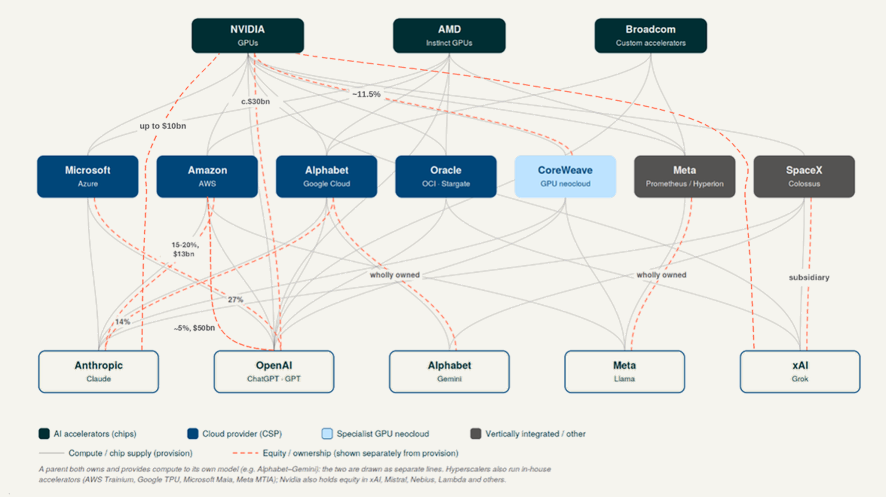
On the current, publicly observable, evidence, we do not observe the pattern of restricted access that anti-competitive input foreclosure would be expected to produce. Rather than restricting access to key inputs, infrastructure providers have generally continued to supply a broad range of downstream rivals, including firms with which they compete. This pattern of supply is illustrated in Figure 2 below, which indicates that the major compute providers each supply and, in several cases, hold equity interests in, multiple competing frontier model developers, while those developers in turn multi-source across more than one provider. We observe a dense web of overlapping supply arrangements rather than exclusive, one-to-one relationships.
A similar pattern appears at the chip level: Nvidia sells its chips to, and has sought partnerships with, buyers throughout the ecosystem – cloud service providers ("CSPs"), neoclouds, established developers and new entrants alike – and invests in firms across that ecosystem, rather than reserving capacity for a favoured downstream partner. This pattern is consistent with an incentive to maximise sales by growing the market rather than to foreclose. Indeed, a range of commentators have highlighted Nvidia’s strong incentives to “commoditise” the foundation model layer in order to drive overall demand for AI and (in turn) its compute capacity.34[For example, CNBC, ‘Nvidia releases Nemotron 3.5 Lightning, open-source AI model’, 11 August 2026, reporting Jensen Huang’s position that “free AI should be great for hardware [and] great for chips”; and Digitimes, ‘Commentary: Nvidia bets on open models to lift GPU usage’, 26 August 2026 (both accessed September 2026). Nvidia has itself released the Nemotron family of open-weights models and is reported to be developing a model of at least one trillion parameters, with the stated aim of enabling more firms and governments to deploy AI independently and so increasing workloads on its hardware.](https://)
Figure 2: Cloud/Compute infrastructure deals and equity relationships between major compute providers and US frontier model developers, as of October 202635Source: RBB Economics analysis based on desk research of publicly available sources Notes: This diagram reflects large compute infrastructure supply deals (e.g., commitments to purchase compute from a given provider or to supply to a given FM developer) and equity relationships identified from publicly available reporting and may not capture every arrangement; some deals are confidential, partial, or unreported, and the picture continues to evolve; figures are provided for equity investments at the time of investment. A parent both owns and provides compute to its own model (e.g. Google-Gemini): the two are drawn as separate lines. Hyperscalers also run in-house accelerators (AWS Trainium, Google TPU, Microsoft Maia, Meta MTIA). The Nvidia-OpenAI equity relationship shown reflects the USD 30 billion stake completed in February 2026, which superseded the September 2025 letter of intent of up to USD 100 billion; the AMD-OpenAI relationship is a performance-vesting warrant of up to approximately 10% of AMD’s shares outstanding, not a completed equity stake
Market outcomes
In addition, we have examined six non-integrated developers, ranging from firms that exited to those still competing: Inflection, Adept, Character.AI, Aleph Alpha, Stability AI and Mistral. In each case, we assess if access to inputs was a key driver of that outcome. In each case, we find that it was not: each had obtained compute at the scale it needed, and struggled or exited for other reasons – most often the cost of financing successive frontier training runs, or the absence of a viable business model.
More generally, the pattern we observe at the FM and application layers is not what we would expect if input foreclosure were occurring. Were rivals being denied compute on competitive terms, the symptoms would typically be visible downstream: entry would be sparse, leading positions would harden, and non-integrated developers would fall away. We observe the opposite – frequent entry, leading positions changing hands or eroding at both layers, and non-integrated developers being among the fastest-growing suppliers. This absence of expected symptoms is not conclusive, but it is consistent with, and supportive of, the conclusions reached on ability and incentive above.
The same pattern holds one layer further down, where FM developers that also offer their own applications supply models to application developers that compete with them. Leading coding tools such as GitHub Copilot and Cursor are multi-model, offering models from Anthropic, OpenAI and Google alongside one another, including models from developers whose own coding tools compete with them. The principal counter-example is OpenAI’s decision in August 2026 to wind down the supply of its models to Cursor following Cursor’s acquisition by SpaceX, the owner of the competing developer xAI.36OpenAI, ‘Our decision on Cursor following its acquisition by SpaceX’, 28 August 2026 (accessed September 2026). OpenAI notified SpaceX that it would wind down its contract providing models to Cursor, with a proposed end of access on 12 November 2026, invoking a change-of-control window. Early evidence points to substitution rather than disruption: OpenAI’s models accounted for around 5% of Cursor’s traffic, and Anthropic committed to expand the capacity available to Cursor.37CNBC, ‘OpenAI to end model access to Cursor after acquisition by Elon Musk’s SpaceX’, 29 August 2026 (accessed September 2026). Cursor's co-founder stated OpenAI models accounted for around 5% of Cursor traffic; Anthropic stated it would expand Claude capacity in Cursor. Because applications can typically draw on several FMs, including open-weights models, the withdrawal of access by a single FM developer does not, on current evidence, appear capable of foreclosing an application rival.
Conclusions and points to watch
In summary, on some measures there is a degree of concentration at the infrastructure layer, as well as increasing interdependency between firms at the infrastructure and FM developer layers. To date, however, the evidence shows broad cross-supply between different firms, including to rivals, and no sign that access to inputs has determined the fate of any developer. This is consistent with an absence, to date, of the ability and incentive needed for input foreclosure to occur, under current market conditions.
Two points, however, warrant ongoing scrutiny. First, whether that pattern of cross-supply gives way to compute suppliers refusing to supply key inputs, alongside a contraction in the viable sources of those inputs or a stall in capacity growth – a combination that would call for more than monitoring. Second, whether Nvidia’s position in AI accelerators proves durable, or is eroded by the merchant market and by the custom silicon now being developed by the large platforms and by FM developers themselves.
Distribution channel foreclosure
The next issue we address is distribution channel foreclosure, i.e., whether any firm has sufficient control over an important route to market or distribution channel to harm rivals at the FM or application layer by restricting their access to customers.38There are a number of active competition investigations which can be broadly characterised as motivated by customer foreclosure concerns. These include Meta in the EU and in the US and the remedies in United States v Google, which reached the company’s GenAI products, barring Google from exclusive distribution and default-placement agreements for the Gemini app and Google Assistant, on the concern that control of device and browser distribution could entrench Google’s own AI against competing developers. We do not comment on these live investigations. European Commission, ‘Commission imposes interim measures on Meta to preserve free access to WhatsApp for rival AI assistants’, press release, 9 June 2026; European Commission, Supplementary Statement of Objections (IP/26/805), May 2026; Meta has announced it will appeal; Federal Trade Commission, ‘Facebook, Inc., FTC v. (FTC v. Meta Platforms, Inc.)’, case page, No. 1:20-cv-03590 (D.D.C.) (both accessed July 2026); and United States v Google LLC, No. 1:20-cv-03010 (APM), remedies opinion (D.D.C., 2 September 2025). As with input foreclosure, we discuss the ability and incentive to foreclose before touching on market outcomes.
Ability to foreclose
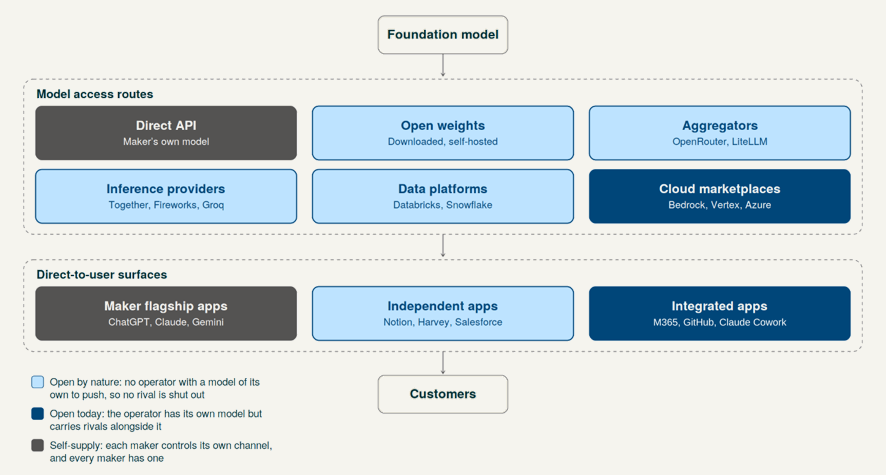
In terms of the ability to foreclose, restricting access to a distribution channel can be used to harm rivals only where it constitutes a genuine bottleneck: important enough that losing access would materially disadvantage a rival and sufficiently concentrated that one firm can determine who reaches customers through that channel. Where several routes to market co-exist, or where no firm controls access to a sufficient portion of the channel in question, the ability to foreclose is correspondingly limited. FMs reach customers through many parallel routes, illustrated in Figure 3: directly through the developer’s own API; through aggregators such as OpenRouter; third-party inference providers such as Together AI or Fireworks AI; data platforms such as Databricks and Snowflake; the cloud marketplaces of the major providers (Bedrock, Vertex AI and Microsoft Foundry); and, for open-weights models, direct download and self-hosting by the customer. FMs also reach customers embedded in their developers’ own flagship apps, in independent products and services, and in enterprise software. In most cases, no single channel constitutes a genuine bottleneck, limiting the scope for customer or distribution foreclosure to undermine the competitive position of rivals.39By way of illustration, a single developer typically reaches customers through several channels at once. Anthropic’s Claude models are available through Anthropic’s own first-party interfaces (the claude.ai web app, its mobile apps and Claude Code) and its developer API; the model catalogues of all three major clouds (Amazon Bedrock, Google Cloud’s Vertex AI and Microsoft’s Azure AI Foundry); the data-platform marketplaces of Databricks and Snowflake; aggregators such as OpenRouter and Poe; and integrations embedded in third-party applications and enterprise software. DeepSeek, an open-weights developer, adds a further route: its models can be downloaded and self-hosted (for example via Hugging Face) as well as accessed through the major clouds, aggregators and independent inference providers such as Together AI and Fireworks.
Figure 3: The foundation model distribution stack40Source: RBB Economics based on desk research of publicly available sources.
For applications, the situation is more nuanced, with certain routes to market mattering more for some applications than others: consumer AI assistants depend on device installation and app-store distribution as well as web visits, whereas enterprise-facing applications reach customers largely through the productivity software suites and cloud marketplaces in which they are embedded. Coding assistants, for example, are distributed in a range of ways, including IDE extension marketplaces. For some specialised applications, a particular channel can be especially important. Whether a particular route to market constitutes a genuine bottleneck will, therefore, depend on the business model and principal routes to market of the application in question.
Incentives to foreclose
In terms of incentives to foreclose, the issue is again one of weighing trade-offs. A firm that shuts rivals out of a channel it controls – a cloud catalogue, an operating system, a device or an app store – gains upstream margin on the sales diverted to its own model or application, but loses downstream: customers value a channel in part for the range of options it offers, and a narrower range makes it less attractive. Foreclosure is only rational where the first effect outweighs the second.
As with input foreclosure, we use market outcomes as a partial indicator of incentives to provide rivals with access to distribution channels.
Taking FMs first, across the various routes to market the pattern is one of general openness rather than restriction: leading providers distribute through several channels at once, and (absent certain niche cases) we are not aware of any concerns that access to distribution has been meaningfully foreclosed to FM providers. Cloud catalogues illustrate the point, although catalogue breadth does not by itself show that access is on competitive terms. Each of the largest platforms carries its closest rivals’ models alongside its own: Google Cloud’s Model Garden, for example, carries Anthropic’s Claude, Meta’s Llama and Mistral AI’s models, alongside Google’s own Gemini and Gemma families.41Google Cloud, ‘Model Garden on Gemini Enterprise Agent Platform’, article (accessed July 2026). Similarly, Microsoft’s Foundry carries OpenAI’s GPT models, Anthropic’s Claude, Meta’s Llama and Mistral’s models, alongside Microsoft’s own Phi family.42Microsoft, ‘What is Microsoft Foundry?’, article, 2 June 2026 (accessed July 2026).
At the application layer, Microsoft provides an instructive example. Despite owning the leading desktop operating system and productivity suite, holding a large stake in OpenAI and enjoying early access to its models, Microsoft has kept its interfaces open: ChatGPT and Claude connect to Outlook, SharePoint and Teams through Microsoft’s own APIs,43Anthropic, ‘Enable and use the Microsoft 365 connector’, Claude Help Center, May 2026 (accessed May 2026). and Microsoft 365 Copilot itself offers Anthropic’s models alongside OpenAI’s.44Microsoft, ‘Expanding model choice in Microsoft 365 Copilot’, 24 September 2025: Microsoft 365 Copilot offers Anthropic’s Claude alongside OpenAI’s models, beginning with the Researcher agent and Copilot Studio and subsequently extending to Copilot in Word, Excel, PowerPoint, and Chat; (accessed July 2026). Control of distribution has not, in this case, translated into leadership.
Conversely, the leaders in consumer assistants (OpenAI) and in enterprise adoption (Anthropic) control no major distribution channel. This shows that control of a distribution channel has not been necessary for these firms to lead to date, although it does not by itself establish that no channel is a bottleneck.
As regards mobile devices, Apple users can now choose which model powers Apple’s own features (although the ‘Hey Siri’ wake word remains reserved for Siri).45On iOS 27, a user can select a third-party assistant to power Apple Intelligence features, but native Siri remains the assistant invoked by the side button and the ‘Hey Siri’ wake word for system control and quick commands, so a third-party assistant cannot take that system position. MacRumors, ‘What to Expect From WWDC 2026’, 5 June 2026 (Apple keeping the wake word and side-button activation for Siri) (accessed July 2026). Android users can also set a rival assistant, such as ChatGPT or Perplexity, as their default assistant and launch it from the power button (although wake-word activation and some system integrations remain with Gemini). In addition, rival assistants can readily be downloaded as apps onto mobile devices, so it is not clear that these channels are restricted in any meaningful sense; deeper integration with the operating system may be better understood as a form of product improvement than as a barrier to reaching users.
Conclusions and future watchpoints
In summary, FMs reach customers through many parallel routes, and no single channel presently constitutes a genuine bottleneck for them: leading providers distribute through several channels at once, and the largest cloud catalogues carry rivals’ models alongside their own. The position is more nuanced at the application layer. The leaders in several segments control no distribution channel at all, and Microsoft’s experience shows that controlling a channel does not guarantee success. But a small number of concentrated channels – operating systems, devices, browsers and large messaging platforms – matter for consumer assistants in particular, and the answer depends on the business model of the application in question.
Notably, authorities are actively pursuing this theory of harm in relation to precisely these channels. In the US, the remedies judgment in United States v Google (September 2025) bars Google from exclusive distribution and default-placement agreements for the Gemini app, as well as for Search, Chrome and Google Assistant.46United States v Google LLC, No. 1:20-cv-03010 (APM), remedies opinion (D.D.C., 2 September 2025), barring exclusive distribution and exclusive default-placement agreements for Google Search, Chrome, Google Assistant, and the Gemini app. In Europe, the European Commission ("EC") is investigating Meta for allegedly abusing a dominant position by updating its WhatsApp terms to block rival, third-party AI assistants from the platform, and has imposed interim measures.47European Commission, ‘Commission imposes interim measures on Meta to preserve free access to WhatsApp for rival AI assistants’, press release IP/26/1276, 9 June 2026 (accessed September 2026). The investigation is registered as Case AT.41034; the interim measures require Meta to re-instate access for third-party general-purpose AI assistants to the WhatsApp Business API on the terms in place before its 15 October 2025 policy change, and do not prejudge the Commission’s final decision. The EC has also challenged Google’s preferential treatment of its own AI assistant on Android: following specification proceedings under the Digital Markets Act ("DMA"), it adopted binding decisions in July 2026 requiring Google to grant rival AI assistants the same system-level access to Android features that it reserves for Gemini.48European Commission, specification decisions under Article 6(7) of Regulation (EU) 2022/1925 (Digital Markets Act) concerning access to Android features for third-party AI assistants and the sharing of Google Search data, adopted 16 July 2026. The proceedings were opened on 27 January 2026, with preliminary findings issued on 27 April 2026. Separately, in December 2025 the EC opened an investigation into whether Google’s use of web publishers’ content for its AI products disadvantages rival AI developers. Note: the Android measures arise under the DMA’s ex-ante regime rather than from a finding of abuse of dominance under Article 102 TFEU.
Two points thus warrant ongoing scrutiny. First, whether any individual channel becomes large enough, and closed enough, to operate as a genuine bottleneck for a particular class of application. Second, whether vertically integrated channel owners begin in practice to favour their own models or applications over those of rivals, notwithstanding the incentives to maintain breadth of choice described above.
Partnerships
Finally, we assess competition concerns that arise from partnerships. The development of frontier AI has been accompanied by a set of significant arrangements linking the largest cloud providers with the leading model developers: Microsoft’s partnership with OpenAI, in which Microsoft holds a stake of around 27%; Amazon’s partnership with Anthropic, in which Amazon has invested on the order of USD 13 billion and serves as Anthropic’s primary training partner, as well as Amazon’s partnership with OpenAI where it has invested USD 50 billion; and Google’s partnership with Anthropic, in which Google holds a stake of around 14%.49The New York Times, ‘Inside Google’s Investment in the A.I. Start-Up Anthropic’, article, 11 March 2025; Microsoft, ‘The next chapter of the Microsoft–OpenAI partnership’, blog post, 28 October 2025; Anthropic, ‘Anthropic and Amazon expand collaboration for up to 5 gigawatts of new compute’, press release, 20 April 2026 (all accessed July 2026); and OpenAI, ‘OpenAI and Amazon announce strategic partnership’, announcement, 27 February 2026 (accessed October 2026). Each combines a minority equity investment with a commercial compute-purchase commitment, and in several cases the two co-develop custom silicon.
More recently, arrangements of this kind have extended beyond the cloud-developer axis and to full acquisitions. Nvidia, the leading supplier of AI accelerators, has invested in nine of the ten most heavily funded private AI companies on the Forbes AI 50.50SOMO, ‘Nvidia's Investment Boom: Europe's AI future in the hands of a US company’, 18 June 2026 (accessed October 2026). In September 2026, Nvidia entered into a definitive agreement to acquire Hugging Face, a hub for open-weights model distribution, after being one of its primary investors.51NVIDIA Corporation, ‘Form 8-K: Current Report (Item 8.01, Other Events) ’, SEC filing, report date 2 September 2026 (accessed October 2026); NVIDIA, ‘NVIDIA to Acquire Hugging Face’, NVIDIA blog, 3 September 2026 (accessed October 2026). Completion is expected in the first half of 2027, subject to regulatory approvals. Nvidia has publicly committed that Hugging Face will remain “an open platform” and “NVIDIA compute will not be required to build on or deploy through Hugging Face”.52NVIDIA, ‘NVIDIA to Acquire Hugging Face’, NVIDIA blog, 3 September 2026 (accessed October 2026).
The concern is twofold. As set out in the FTC Staff Report on AI Partnerships & Investments 6(b) Study (FTC Staff Report), an equity stake entitles the cloud provider to a share of the partner’s profits and may give it an incentive to favour that partner over rivals reliant on the same infrastructure: an input-foreclosure-like concern that strengthens with the size of the stake. In addition, contractual terms such as exclusivity, most-favoured-nation clauses, minimum-spend commitments and first-refusal rights could restrict a developer’s ability to deal with other providers. The report flagged three areas to watch: access to key inputs such as compute and talent, switching costs, and access to commercially sensitive information.53Federal Trade Commission Office of Technology, ‘Partnerships Between Cloud Service Providers and AI Developers: FTC Staff Report on AI Partnerships & Investments 6(b) Study’, report, Chapter 5, January 2025 (accessed May 2026). Note: The report was a market study rather than an enforcement action and described the commercial terms gathered without identifying any concrete instance of competition or innovation having been stifled.
A related US concern is the use of licensing-and-hiring arrangements, or ‘acqui-hires’, such as Microsoft/Inflection, Amazon/Adept and Google/Character.AI. In January 2026 the FTC Chairman stated that the agency had begun examining whether such arrangements are reportable under the HSR Act or structured to avoid notification; no enforcement action had been brought at the time of writing.54A. Ferguson, Chairman, Federal Trade Commission, interview with Bloomberg Television, ‘FTC Will Review Acquihires, Chair Ferguson Says’, 16 January 2026 (accessed September 2026). Ferguson stated the agency was 'beginning to examine these acqui-hires' to ensure they are not attempts to avoid merger review, that no single rule defines when such arrangements are reportable under the HSR Act, and that the FTC may issue additional guidance. Contemporary reporting of the interview noted that while such deals have faced regulatory scrutiny, none had been unwound: Reuters, ‘US FTC to scrutinize Big Tech’s talent acquisition deals, Bloomberg News reports’, 16 January 2026 (accessed October 2026).
Importantly, partnerships (and more formal acquisitions) also have the potential to generate strong pro-competitive benefits: frontier development is exceptionally capital-intensive, with risky returns over long horizons, and these arrangements are the principal mechanism by which capital-constrained developers obtain the capital, compute and distribution they need to reach the frontier. Viewed in that light, they have the potential to enable entry and expansion at the FM layer and other layers rather than barring it.
Assessment
We assess partnerships in the same way as the foreclosure theories above: whether these arrangements have in practice been accompanied by restrictions on rivals, and whether there is evidence consistent with their pro-competitive effects – entry and expansion coinciding with the capital and compute supplied, and continued dealing with rival suppliers. We consider two groups in turn: the bilateral partnerships between cloud providers and frontier developers that were the focus of the FTC Staff Report; and Nvidia’s diversified investment programme. This evidence establishes association rather than causation, and we have not modelled how each stake alters the incentives of the firms concerned.
For bilateral partnerships, the nature of these relationships has become less exclusive over time, not more, which points against foreclosure theories. OpenAI ran exclusively on Azure from 2019 to January 2025, when that exclusivity was replaced by a right of first refusal under which Microsoft could match new compute capacity that OpenAI sought; in October 2025 Microsoft gave up that right as well.55Microsoft, ‘Microsoft and OpenAI evolve partnership to drive the next phase of AI’, blog post, 21 January 2025; Microsoft, ‘The next chapter of the Microsoft–OpenAI partnership’, blog post, 28 October 2025. OpenAI has since added capacity from Oracle, CoreWeave, Google Cloud and AWS while retaining a very large Azure commitment; the change appears to have been driven by commercial necessity, as OpenAI’s demand had outgrown what Microsoft alone could supply. Anthropic, although AWS is its primary training partner, has layered substantial commitments with Google, Azure and xAI on top of that relationship. Microsoft, for its part, offers Anthropic’s models alongside OpenAI’s in its own products. In each case, the developer multi-sources across its backer’s closest rivals, and the backer deals with its partner’s rivals.
The terms that remain – including Microsoft’s rights over OpenAI’s intellectual property and the exclusivity of OpenAI’s API products on Azure – are the type of term that the FTC Staff Report identified as capable of restricting a developer’s dealings with other providers, and they warrant monitoring.56Microsoft, ‘The next chapter of the Microsoft–OpenAI partnership’, blog post, 28 October 2025, which states that Microsoft’s IP rights are extended through 2032 and that Microsoft retains Azure API exclusivity until AGI is declared. On the current evidence, however, they have not prevented OpenAI from sourcing very substantial compute capacity elsewhere.
Nvidia’s investment programme provides a relevant case study of a diversified investment and partnership strategy. Between 2021 and 2025 Nvidia participated in 283 funding rounds across 241 companies, and nine of the ten most heavily funded private AI companies on the Forbes AI 50 – firms that compete directly with one another – had received Nvidia investment.57SOMO, ‘Nvidia's Investment Boom: Europe's AI future in the hands of a US company’, 18 June 2026 (accessed October 2026). At the model layer, that includes approximately USD 30 billion in OpenAI in February 2026, large rounds for Anthropic and for xAI, repeat investments in Mistral AI, Cohere and Perplexity AI, and USD 5 billion in Safe Superintelligence.58On OpenAI: CNBC, ‘OpenAI announces $110 billion funding round with backing from Amazon, Nvidia, SoftBank’, 27 February 2026; on Anthropic: NVIDIA, ‘Microsoft, NVIDIA and Anthropic Announce Strategic Partnerships’, NVIDIA blog, 18 November 2025; on xAI: xAI, ‘xAI Raises $20B Series E’, company announcement, 6 January 2026; on Mistral AI, Cohere and Perplexity AI: SOMO, ‘Nvidia's Investment Boom: Europe's AI future in the hands of a US company’, 18 June 2026; and on Safe Superintelligence: Bloomberg, ‘Nvidia to Invest $5 Billion in Ilya Sutskever's AI Research Lab’, 27 July 2026 (all accessed October 2026). At the infrastructure layer it includes USD 2 billion each in CoreWeave and Nebius, giving stakes of around 11.5% and 9.3% respectively.59Futuriom, ‘NVIDIA Tops CoreWeave Stake with $2 Billion’, 26 January 2026 (reporting NVIDIA's 11.5% stake per its SEC filing); Investing.com, ‘Nvidia discloses 9.3% stake in neocloud computing firm Nebius’, 20 July 2026 (both accessed October 2026). By July 2026 Nvidia’s equity investments stood at approximately USD 99 billion.60NVIDIA Corporation, ‘Form 10-Q for the quarterly period ended July 26, 2026’, SEC quarterly report, p. 26 (accessed October 2026). “We have made, and may continue to make, investments and commitments in our ecosystem to enhance our growth opportunities, cultivate our ecosystem, and strengthen our competitive position. These include equity investments of $99 billion and equity investment commitments of $25 billion as of July 26, 2026.”
The recipients have grown accordingly. Perplexity’s annualised revenue rose from under USD 250 million at the start of 2026 to over USD 750 million;61Reuters, ‘Nvidia discusses Perplexity investment at US$30 billion plus valuation, The Information reports’, 24 August 2026 (accessed October 2026) Mistral AI and Cohere have each raised repeatedly and continued to scale as independent developers;62See Section 8.3 in the report. and specialist cloud providers such as Nebius have expanded capacity materially while serving customers across the ecosystem.63Nebius Group N.V., ‘Nebius signs new AI infrastructure agreement with Meta; deal to accelerate growth of Nebius's core business in AI cloud’, press release, 16 March 2026 (accessed October 2026). CoreWeave saw its market capitalisation rise from around USD 23 billion at listing in March 2025 to over USD 48 billion by August 2026.
Moreover, the firms receiving that capital have continued to deal with Nvidia’s rivals as well as with Nvidia. Anthropic’s primary training partner is AWS, running on Amazon’s own Trainium silicon, and it also uses Google’s TPUs; both were developed by firms alongside which Nvidia has invested, and both compete directly with its GPUs.64See Section 6.2 in the report. OpenAI and Anthropic have each also begun the process of designing their own inference processors.65See Section 6.2 in the report. This evidence is by no means determinative that partnerships are universally positive. It is also drawn from large, well-resourced firms with the scale to multi-source compute or design their own silicon – precisely the firms best placed to resist foreclosure, were it attempted. A smaller rival without comparable bargaining leverage could face a materially different position, and would not necessarily be visible in the evidence considered here.
More generally, there is a range of clear examples where investments or partnerships would appear to have been a strong driver of growth and competition in the AI sector. Anthropic scaled on Amazon’s investment on the order of USD 13 billion and Google’s stake of around 14%, together with the compute those partners supplied, and went on to increase its share of US enterprise model spending from around 12% to approximately 40%, overtaking OpenAI on annual recurring revenue during the first quarter of 2026. This illustrates a partnership enabling a developer’s own growth, and is consistent with the pro-competitive account of these arrangements. It does not, however, directly address whether other, non-partnered developers were disadvantaged as a result, which is the question the foreclosure theory of harm is concerned with, and would require evidence of outcomes for rivals excluded from equivalent arrangements, rather than outcomes for the partnership’s own beneficiary.
Conclusions and watchpoints
In summary, the evidence indicates that the partnerships examined have, to date, enabled entry and expansion at the FM layer without the exclusivity that would be needed to foreclose rivals: the leading developers multi-source across their backers’ competitors, and their backers distribute rival models. On balance, these partnerships appear more likely to have promoted competition and innovation than to have hindered it. Our evidence is drawn mainly from large, well-resourced developers, however, and does not exclude the possibility that smaller firms without comparable arrangements have been disadvantaged.
That is not to say that no partnership could ever give cause for concern, and two points warrant ongoing scrutiny. First, the terms of these arrangements rather than their existence: the removal of OpenAI’s Azure exclusivity is central to our conclusion, and any move towards exclusivity, most-favoured-nation clauses or more restrictive first-refusal rights – including any reintroduction of such rights in the Microsoft–OpenAI relationship – would change the analysis. Second, structural change at either end of the chain: were concentration at the infrastructure or model layer to increase materially, a strategy that is presently unprofitable could become profitable, and transactions that convert a partnership into control – or that link an input supplier to a distribution channel, as Nvidia’s proposed acquisition of Hugging Face would – fall to be assessed on their own facts (taking into account both the potential pro- and anti-competitive effects).
Conclusions
Taken together, the evidence assessed in this report is consistent with effective competition in the GenAI sector, though this is based on a short and unusually dynamic period. At the foundation model and application layers, shares of supply have moved repeatedly and substantially, entry has been frequent and leading positions have changed hands within months rather than years in many areas.
On the practices examined – input foreclosure, distribution channel foreclosure, and partnerships and ownership stakes – the observable market evidence shows firms continuing to supply and deal with their rivals in a wide range of cases.
That conclusion is, however, accompanied by a number of significant watchpoints: were entry to slow or leading positions to become durable and resistant to competitive erosion, the analysis would need to be revisited. In particular: concentration is greater at the compute and chip layers than further downstream, and the incentive to favour affiliates would strengthen if growth in compute capacity stalled; switching costs could rise as agentic deployments deepen; a small number of device and platform channels have the potential to be bottlenecks for consumer assistants; the terms of partnerships would change the analysis if they became more restrictive; transactions that convert a partnership into control, or that link an input supplier to a distribution channel, should be assessed on their own facts (taking into account both pro- and anti-competitive effects); and pricing outcomes warrant continued monitoring against capability-adjusted benchmarks.
Regulatory developments warrant particular attention. Investment and entry to date have taken place against a deliberately pro-innovation federal stance, although obligations on frontier developers are emerging at state level, and the fixed costs of ex-ante compliance fall disproportionately on recent entrants and open-weights developers – precisely the firms from which much of the competitive pressure documented here originates. On the current evidence, intervention against arrangements that are presently enabling entry and expansion would carry a real cost, in slower development of these markets, that would need to be weighed against any corresponding gain for competition – recognising that such interventions may in some cases be justified on safety rather than competition grounds. Whether the risk of such intervention presently outweighs the risk of under-enforcement is a policy judgment that goes beyond the market-outcomes evidence set out in this report.
In our view, the evidence therefore favours vigilance over pre-emption. Competition authorities should keep the watchpoints above under active review and investigate specific conduct where it raises genuine concerns, using existing antitrust tools, which recent cases show are capable of addressing problems at individual channels. Broad, pre-emptive intervention in a sector still being shaped by entry and rapid innovation risks constraining the very firms driving that competition, and is not warranted on the evidence to date.
References
- 1.
- 2.
Epoch AI, ‘Data on AI Models’, interactive data explorer, updated 19 June 2026 (accessed June 2026).
- 3.
Arena Intelligence, ‘Text Arena – Coding’, data dashboard (accessed July 2026).
- 4.
- 5.
- 6.
- 7.
- 8.
- 9.
- 10.
Databricks, ‘State of AI Agents’, report, 27 January 2026 (accessed June 2026).
- 11.
- 12.
- 13.
Token Price Index (TPI), ‘AI Token Price Index’, data dashboard (accessed 15 July 2026).
- 14.
- 15.
- 16.
- 17.
- 18.
See the Menlo Ventures and Sapphire Ventures sources cited in the preceding footnote.
- 19.
- 20.
- 21.
- 22.
- 23.
- 24.
- 25.
- 26.
- 27.
- 28.
- 29.
- 30.
- 31.
- 32.
- 33.
- 34.
- 35.
- 36.
- 37.
- 38.
- 39.
- 40.
Source: RBB Economics based on desk research of publicly available sources.
- 41.
Google Cloud, ‘Model Garden on Gemini Enterprise Agent Platform’, article (accessed July 2026).
- 42.
Microsoft, ‘What is Microsoft Foundry?’, article, 2 June 2026 (accessed July 2026).
- 43.
- 44.
- 45.
- 46.
- 47.
- 48.
- 49.
- 50.
- 51.
- 52.
NVIDIA, ‘NVIDIA to Acquire Hugging Face’, NVIDIA blog, 3 September 2026 (accessed October 2026).
- 53.
- 54.
- 55.
- 56.
- 57.
- 58.
- 59.
- 60.
- 61.
- 62.
- 63.
- 64.
- 65.
Our experience and expertise means our clients have the best chance of success before competition authorities and courts.
We have unrivalled experience across the full range of issues presented by competition law and related associated litigation.


Articles
All Articles- Generative AI: an assessment of competitive dynamics (US edition)
